


From Cup To Menu
In the previous sections, Peru has been explored through people, systems, varietals, and place. But for a roaster, the final question is always the same: How does it perform in the cup — and where does it fit?
To answer this, Khipu worked with three coffee professionals approaching quality from different but complementary perspectives.
Lukas Haertel brings a background in roasting and green buying, with over seven years of experience across production, quality control, and sourcing, including leadership roles at WatchHouse. His work focuses on how coffees behave through roasting and how they translate into real-world menu decisions.
Fabiana Carvalho offers a different lens. A PhD researcher and founder of The Coffee Sensorium, her work explores how coffee is perceived — how aroma, flavour, texture, and time interact in the cup.
Gracia Briceno brings the perspective of competition roasting. Owner and roaster of MamaQuilla Coffee Roastery in Lima, she has been part of Peru's Cup of Excellence roasting team since 2021, working directly with the country's highest-scoring lots under conditions where precision is non-negotiable.
Together, these three perspectives allow for a more complete view — not just what these coffees taste like, but how they behave, and how they can be used.
What the Cup Reveals
In January 2026, Khipu cupped 26 lots from the 25/26 harvest — all coded by number rather than name. No origin. No producer. Just the coffee.
What came through was not a random varietal. It was a set of repeating patterns: jasmine and violet appearing across washed lots from different regions; peach, chamomile, and honey recurring as structural markers; naturals staying clean and ripe — juicy rather than ferment-driven. One yellow honey landed as milk chocolate, butterscotch, and chocolate chip cookie warmth — a profile so coherent it needed no context to read.
That consistency, across a blind table, is where this analysis begins. Across those 26 cups, a pattern emerges. Not in flavour, but in structure.
As Lukas observed, regardless of process, varietal, or region, the coffees consistently show high sweetness supported by bright, structured acidity. This becomes a defining characteristic.
The coffees tend toward integration — fruit, sweetness, and acidity moving together. Clarity without tension. Expression without instability
This is notable given Peru's diversity. Coffees from Cajamarca, Amazonas, Cusco, and Pasco — under very different conditions — still arrive at a similar structural balance.
Another feature becomes apparent with time. Many of the coffees do not peak early. They open as they cool.
As temperature drops, sweetness deepens, acidity sharpens, and additional layers emerge. For a roaster, this signals high density, well-developed sugars, stable organic acids — and how the coffee will respond in roasting.

Lukas draws a comparison that is more instructive than it might first appear. Across the better lots, he notices a similarity to washed Kenyan coffees: clean, structured, and expressive, with high berry acidity. He attributes it to processing discipline — the same care in fermentation and washing that produces structural clarity. A reference point that positions Peru alongside rather than below.
His relationship with Peruvian coffee has shifted considerably.
"Up until a few years ago," Lukas says, "I only knew Peruvian coffees as high quality, consistent community lots with high sweetness and good structure. In the past five years, coffees from Peru are raising the bar every year."
Naturals follow the same logic. They remain clean and balanced — not dominated by fermentation, but defined by restraint. Juicy and ripe rather than heavy.
Cupped blind, a coffee from Peru does not announce itself loudly.
"If an origin doesn't expose itself in a blind cupping," Lukas says, "it means it's likely something like Colombia, Costa Rica, or Peru." He means it as a compliment — a coffee with no ceiling, and nothing to hide.
Time in the Cup
If structure defines how a coffee is built, perception defines how it is experienced. Fabiana Carvalho approaches this through flavour chemistry and sensory behaviour over time.
The aromatic lift that opens many of these cups — floral and citrus notes — is driven largely by volatile compounds such as terpenes. These create brightness and clarity, but they fade quickly.
Lactones behave differently. They contribute roundness and softness — often associated with peach, mango, or creamy textures — becoming more apparent as the initial lift settles.
What matters is not just what is present, but when it appears. As the cup cools, flavour evolves — and perception shifts.
A coffee that opens as soft tropical fruit can shift toward sharper acidity as it cools. Mango becomes pineapple — not because the flavour changed, but because the balance of acidity and sweetness did.

This temporal movement is central to how these coffees are experienced. Equally important is alignment. Where coffees perform best, flavour elements move together.
In the January 26 cupping, that alignment was visible in the cup. One lot opened with jasmine, peach, and honey — a delicate, coherent profile where each note reinforced the others.
Another arrived as milk chocolate, butterscotch, and warm cookie sweetness — a dense, rounded expression where everything belonged together. A third moved through violet, blackcurrant, and panela, all sharing the same rich, dark register.
When elements align like this, the cup feels resolved. When they don't, even attractive notes pull against each other. The cup sounds uncertain even when the individual notes are appealing.
Taken together, these observations point to something broader: Peruvian coffees are not defined by a single flavour profile — but by how flavour develops, integrates, and persists.
Roasting Under Pressure
If cupping reveals structure, roasting reveals behaviour.
Gracia Briceno has been part of Peru's Cup of Excellence roasting team since 2021, working with some of the country's highest-scoring coffees under conditions where precision is absolute.
The samples arrive fully coded — no origin, no producer. She doesn't learn where a coffee is from until after every roasting decision has already been made. Everything she works with comes from the physical data of the coffee itself: density, moisture, water activity, process, and bean structure. It is a deliberately neutral environment, and within it, every decision is made on evidence alone.
Each coffee must be interpreted quickly. These variables determine how it will receive heat, how it will develop, and where clarity will emerge.
Gracia works closely with the lead judge, adjusting profiles in real time — energy application, development time, and roast curve — to find the point where the coffee opens without losing structure.
The goal is not consistency of profile. It is precision of expression.
Across recent harvests, the shift is clear.
Peruvian coffees are becoming more diverse — more varietals, more processing — but also more precise. Brighter acidity, cleaner finishes, more defined aromatics.
What stands out is not intensity, but control.
Denser, high-altitude lots require careful energy management through drying and Maillard phases. Handled correctly, they maintain structure. Without precision, that structure breaks.
These are not fragile coffees. They are responsive ones.
"The true value of coffee emerges when we connect the producer, the roaster, and the consumer in a shared story." — Gracia Briceno

The Cherry, the Slope, the Ferment
Peruvian coffee is shaped long before it is tasted.
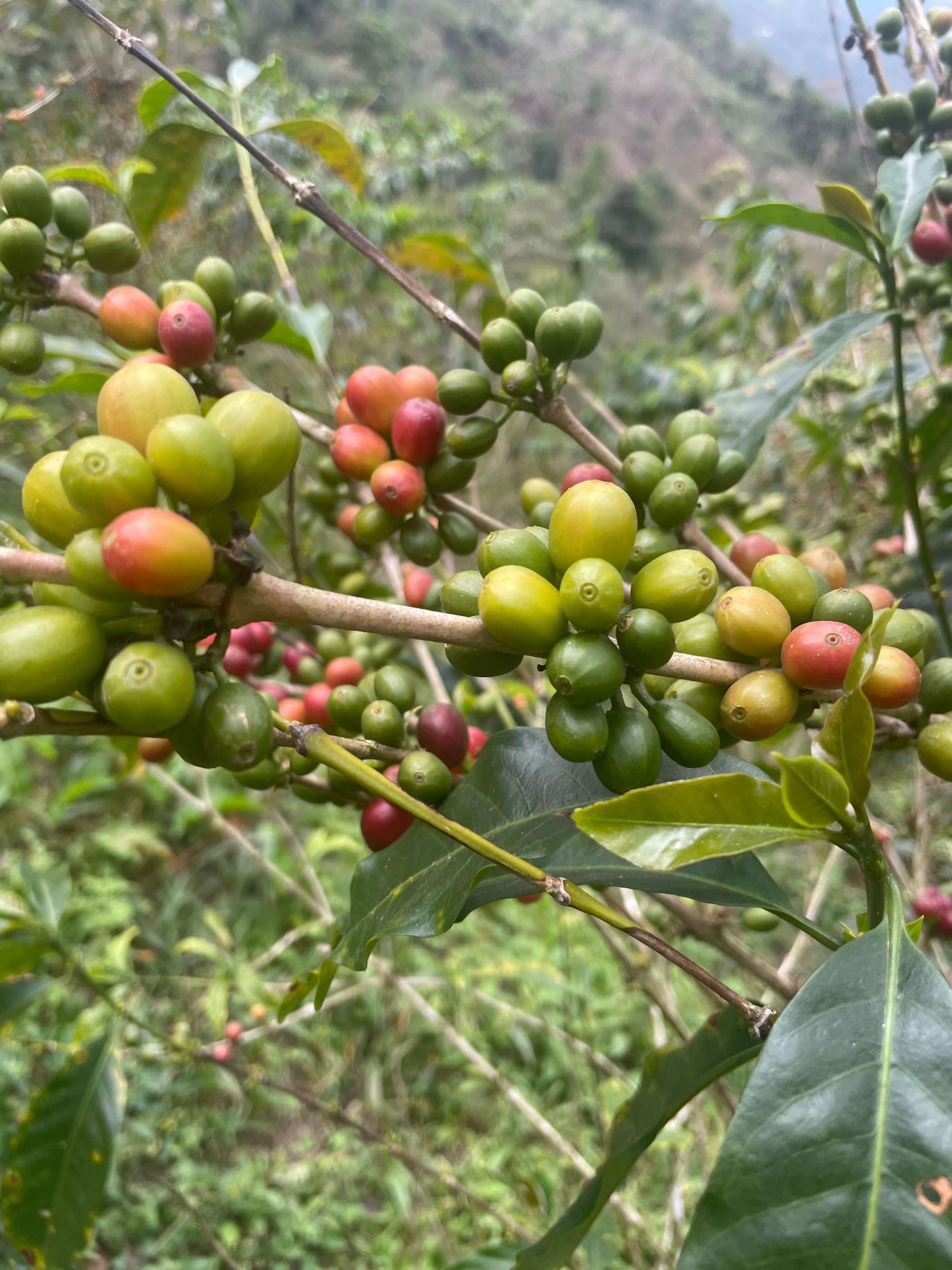
High altitude slows cherry maturation, increasing sugar concentration and preserving organic acids. This produces denser seeds with more complex internal structure.
Amazon-facing slopes introduce humidity, cloud cover, and diffused sunlight. These conditions extend ripening and stabilise development.
Fermentation acts as a final stage of transformation — not creating flavour, but unlocking compounds already present in the cherry.
Together, these forces define the potential of the coffee.
How It Moves
Lift → Integration → Silk → Finish
That potential expresses itself through a consistent sensory progression.
1 — Aromatic Lift Floral, citrus, tea-like aromatics dominate the opening.
2 — Structural Integration Fruit and sweetness align — balance over intensity.
3 — Silk & Sweetness Texture becomes visible — caramel, panela, soft fruit.
4 — Finish & Persistence Clean, extended, often tea-like clarity.
Peru is not defined by flavour. It is defined by how flavour develops.

From cup to menu
The clearest conclusion is not how these coffees taste. It is how they function.
Peru is no longer a narrow origin with a single role — it is an origin that can be built into a full menu, from foundational espresso to competition-level filter.
This is made possible by a consistent structural foundation: sweetness, balanced acidity, and clarity.
Peru is no longer an origin you discover late. The roasters who moved early already know what the next few harvests will bring.
Structure. Sweetness. Clarity. A sensory progression that develops rather than announces itself. Peru is not an origin defined by a single flavour — it is defined by how flavour moves. That understanding changes how you buy. The lots available from the 25/26 harvest are listed below — each one shaped by the people, systems and conditions explored throughout this guide. This is where the story becomes something you can actually put on your menu.
→ Read next: The 25/26 Offer List