


"For years, we sold it as Geisha."
That's how Saulo Ibias of Finca Tres Cedros, in Inkawasi (Cusco), describes a coffee that would later become one of the most important discoveries in Peru's recent history.
At the time, there was no reason to question it. The cup profile made sense — floral, expressive, refined. Buyers accepted it. Producers believed it. And so the name held.
But over time, small inconsistencies began to surface. Not in the cup, but in the details that surround it. The shape of the bean. The structure of the plant. Subtle differences that didn't quite fit.
Small at first — but persistent.
What began as a question about classification would eventually become something much larger: not just what this coffee was — but what Peru had been growing all along.
This is the story of SL09 — a varietal once mistaken for something familiar, now emerging as part of a deeper shift in how Peruvian coffee is understood.
Not as an imitation. But as something of its own.
The Seed and the Assumption
To understand how that happened, you have to go back to where the seeds came from.
"The seeds arrived more than 25 years ago in Acconcharcas," Saulo explains. "A neighbouring producer, Julian Vilchez, received them from his brother Rogelio Vilchez, who was studying in the city of Cusco. Some locals gave him the seeds, claiming they were Geisha seeds. From there, they spread."
This is how varietals often move in coffee. Not through institutions. Not through formal identification. But through people. Seeds are shared. Planted. Observed. Trusted. Over time, that trust becomes identity.
"I hadn't visited other farms outside the country producing Geisha," Saulo says. "But in my Q grader courses, the profile was similar — floral and fruity — so I believed that what we had was Geisha."
The assumption was not careless. It was reasonable. And it lasted for years.
The Shape of the Bean
What changed was not the coffee. It was the attention paid to it. As more buyers encountered these coffees, the same question kept returning. If this is Geisha — why doesn't it look like it?
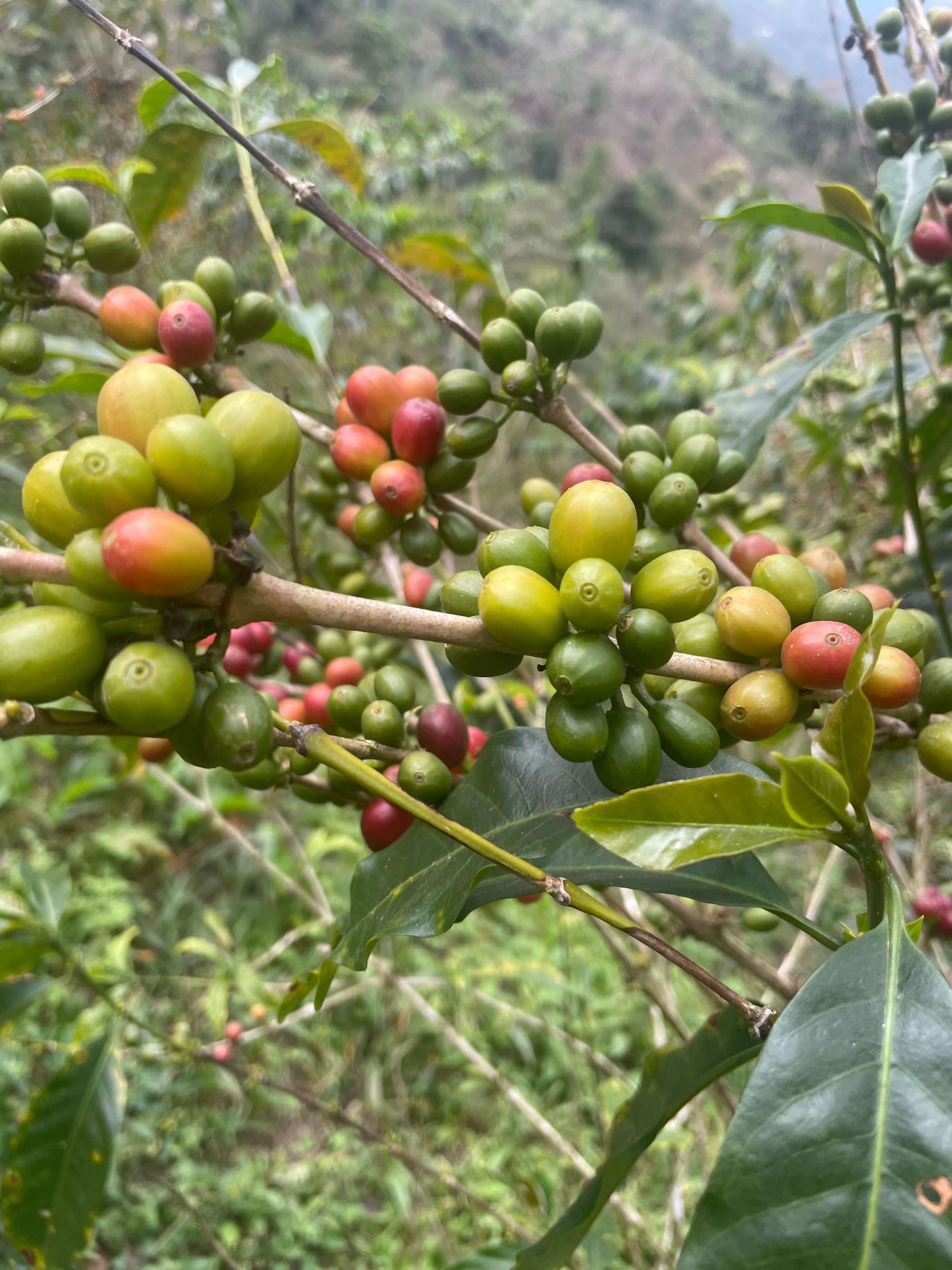
The bean shape was wrong. Geisha produces an elongated, pointed bean. What Saulo and his neighbours were growing had a medium-round bean — a consistent and visible difference that buyers couldn't reconcile with the varietal they thought they were purchasing.
And in coffee, small differences rarely stay small. "Our customers kept asking," Saulo says. "They couldn't understand it."
Among them was Lance Schnorenberg, co-founder at SEY Coffee in New York. It was his persistence — returning again and again to that question of the grain shape and the clearly marked location — that eventually pushed the next step.
Samples were taken. Leaves were sent. And for the first time, the question moved from the cupping table to the lab.

Only Similar to an SL09
The results did not confirm what people expected. They complicated it. The varietal was not Geisha.
Instead, genetic analysis showed that it belonged to the Ethiopian Legacy group, and was very close to a rare cultivar known as SL09.
"According to the results, this type of coffee doesn't exist in their database," Saulo explains. "It is only similar to an SL09." That distinction matters.
Not identical. Not fully traceable. But clearly something else. For Saulo, the result was not just a correction — it was a shift in understanding.
What they had been growing, sharing, and selling for years was not a variation of something known.
It was something that had never been properly understood.
The Lost Records
These findings were not isolated. They form part of a broader effort within the specialty coffee industry to better understand the origins of so-called "Inca Geisha" coffees.
Initial testing — driven by buyer curiosity and supported by New York-based SEY Coffee — was carried out by RD2 Vision, the laboratory led by Christophe Montagnon, whose work in genetic fingerprinting has become a global reference point.
The results consistently placed these coffees within the Ethiopian Legacy group and very close to SL09 — despite no clear historical record of how such material reached Peru.
Writing on this subject, Christopher Feran notes that this discovery complicates the narrative of Geisha in Peru, suggesting that what has long been assumed to be a known varietal may instead represent a distinct lineage now emerging into view.
The implications go beyond naming. Because while the genetic fingerprint provides direction, it does not provide a complete history.
How did a cultivar closely related to SL09 — a selection not widely distributed — come to exist across farms in Peru? There is no single answer.
Records of mid-century agricultural research, including varietal trials and germplasm introductions, were largely lost. Informal exchange of seeds over decades further obscures the path.
What remains is not a clear origin story. But a clear reality. The coffee exists. It performs. And it has been there longer than anyone realised.
The Cup as Proof
For Saulo, the distinction was never just theoretical. It was always in the cup.
"The SL09 is a complete varietal," he says. "It has floral and fruity attributes, a bright appearance, and a nice creamy body." That idea of completeness is key.
Because while the coffee shares certain traits with Geisha — floral aromatics, lifted fruit — it expresses them differently. Less sharp. More integrated. More structured.
Across tastings, similar patterns emerge:
jasmine and floral aromatics
peach, citrus, and tropical fruit
honeyed sweetness
a rounded, creamy body
It does not replace Geisha. It sits beside it. A different expression of clarity and sweetness. And once that difference is recognised, it becomes difficult to ignore.
How it is processed changes what you hear in the cup. A washed SL09 brings precision — the floral and fruit notes in sharper focus, the structure more defined. A natural process opens something different: more depth, more complexity, more weight behind the sweetness. Both are valid expressions. Neither is the definitive one.
"The washing process is spectacular," Saulo says. "But a well-made natural is amazing."

Twice the Yield
Recognition alone is not enough. For a varietal to matter, it must work beyond the cup. This is where SL09 changes from interesting to important.
"There is a huge difference with Geisha in terms of productivity," Saulo explains. "You could say double."
The contrast is clear:
more branches
taller plants
stronger resistance to cold
viability at altitudes above 2500 masl
Where Geisha often requires careful management and produces limited yields, SL09 offers a different balance. Quality and resilience.
"It allows us to differentiate ourselves," Saulo says, "and maintain good prices due to its scarcity, benefiting all our producers."
This is where the story shifts. From discovery — to application.
Recognition Before Understanding
Perhaps the most striking part of this story is that recognition came before understanding. "In 2020, we achieved first place," Saulo says. "But under the name Geisha, because there was no awareness of the varietal at that time."
The coffee was already performing at the highest level. The name simply hadn't caught up. Years later, that performance continues.
"In 2026, with a natural process, it reached 4th place in the Cup of Excellence."
That consistency matters. Because it confirms something essential: The value of the coffee does not depend on how it is labelled.
It depends on what it is.
Naming What Was Already There
With the genetic results, the coffee gained a new reference point: SL09. But another name remained.
"We decided to call it Inca Geisha," Saulo explains, "since Inkawasi was where the last Incas lived."
Two names, describing the same coffee. One scientific. One cultural. Rather than resolving that tension, it may be more accurate to accept it. Because identity in coffee is rarely singular.
It is built from: genetics, place, people, and time
SL09 describes its lineage. Inca Geisha describes its context. Both are true.
Newly Understood, Not Newly Discovered
"We are working to make this varietal representative of Peru," Saulo says — the way Sidra has become representative of Ecuador. For producers, that means something practical.
Better prices. Greater recognition. A way to differentiate in a market that often reduces origins to familiar profiles. But the significance goes beyond that. Because what SL09 represents is not just a varietal — it is a shift in perspective.
For years, Peru has often been understood in relation to other origins. Compared. Benchmarked. Positioned within categories defined elsewhere. SL09 suggests something different. Not a response. Not a replacement. But a contribution.
A coffee that may have been present for decades, now emerging into view through a combination of producer experience, market curiosity, and scientific understanding.
It wasn't newly discovered. It was newly understood.
The goal, Saulo says, is to regain first place—and to do it this time under the right name.
Not as Geisha. As what it actually is. And with that, something begins to change. Not just in how Peru is seen—but in how it defines itself.
If SL09 represents identity, what follows is ambition.
SL09 reframes what Peru is. Not an origin defined by comparison to others, but one with its own distinct lineage — already performing at the highest level, already present for decades, now finally seen on its own terms. That shift in identity changes what ambition looks like at origin too. In the sections that follow, producers are not chasing trends or replicating what works elsewhere. They are adapting, experimenting and making decisions under real pressure — building something that belongs specifically to Peru.
→ Read next: Controlled Ambition — adapting under pressure at origin